


Share the Bean: A Citizen Science Experiment
- Why Conservation of Local and Traditional Varieties Is Important for Humanity
The Roots of Crop Diversity
Have you ever wondered where the huge variety of fruits, vegetables, and grains we enjoy today came from?
For thousands of years, farmers around the world have been cultivating wild plants. Over generations, they selected those that grew best, tasted better or were easier to harvest. This process of domestication began in the Neolithic Age, around 10,000 years ago and forever changed how humans and nature interact.
Domestication of crops and animals occurred roughly between 10,000 and 5,000 years ago in several world regions: the Middle East and Mediterranean Basin, East and West Africa, Mesoamerica, the Andean region of South America, China and India.
Through domestication, wild plants were gradually reshaped to suit human needs: edible parts became larger and more colourful and a remarkable diversity of crops emerged, each with unique traits.
As Charles Darwin noted in The Origin of Species, this variation in domesticated crops demonstrates humanity’s power to guide evolution. By choosing plants with desirable features, people created crops capable of thriving in many environments, from dry deserts to cold mountains, while also matching local tastes, colours and textures.
The Common Bean as an Example of Domestication
The common bean (Phaseolus vulgaris) illustrates how domestication drives diversity. Its wild ancestor arose in Central America (modern Mexico) and spread to South America about 200,000 years ago, forming two wild gene pools: Mesoamerican and Andean.
People domesticated both gene pools independently, earlier in Mesoamerica, about 9,000–8,000 years ago. Andean beans evolved larger seeds. Mesoamerican beans adapted to diverse soils and climates.
Early domesticated beans were sensitive to day length, which controls flowering. As farmers cultivated them in warmer, lower regions, they selected plants that flowered earlier and grew under different photoperiods.
Distinct “races” emerged: Jalisco, Durango and Mesoamerica in Mexico, Peru and Chile in South America. In Europe, the bean arrived through seeds brought by the Spanish after the conquest of Peru. Emperor Charles V presented them to Pope Clement VII, who promoted their spread, helped by Piero Valeriano Bolsanio of Belluno, the Pope’s secretary from the Medici family. Later, Mesoamerican material was also introduced, further broadening diversity.
Over millennia, farmers created numerous local varieties, or landraces, each adapted to its specific soil, climate, and symbiotic Rhizobium bacteria that fix nitrogen in the soil. People selected beans for taste, cooking quality, pest resistance and even for edible pods, fresh green beans, developed independently in several regions, showing humanity’s creativity in making food more versatile and enjoyable.
What Are Plant Genetic Resources?
All these varieties together form what scientists call Plant Genetic Resources (PGR), the living library of genetic information for all crops. They include:
- Wild relatives of cultivated species
- Domesticated forms, such as
- Landraces – traditional, locally adapted varieties
- Modern varieties – bred mainly over the last two centuries
Landraces evolved through centuries of farmer selection to perform optimally in local environments, integrating human needs, soil and climate. They thrive under low-input conditions (limited fertiliser or pesticides) and maintain high internal diversity, many genotypes coexisting and co-adapting, which gives them natural resilience to pests, drought and poor soils.
In contrast, modern varieties are uniform and optimised for yield potential, but depend heavily on chemical inputs and irrigation.
Why Conserve Local Varieties?
Although modern varieties are important, traditional and wild types are the foundation of global food security. They hold the raw genetic material that breeders and farmers use to create tomorrow’s crops with many traits of interest related to adaptation to different environments, to develop positive interaction between plants of the same or different species to favour the mutualistic interaction in heterogeneous variety often use in organic farming or intercropping between different species. Finally, traditional varieties have a large diversity for many traits related to nutritional value and adaptation to harsh environments.
Losing them means losing them forever as the genetic resources cannot be replaced:
- Indeed we will loose traits that enable plants to resist drought, floods, pests, or diseases
- Options for cultivation in harsh or changing environments
- Cultural heritage taste and traditional cuisines. Humanity’s biological “insurance policy” for the future
Once a local variety and wild relative disappears, they are irreplaceable. That is why genebanks worldwide conserve seeds and living plants to safeguard this diversity for coming generations. And for the same reason, INCREASE proposes to develop decentralised conservation to make all this diversity available to citizens, favouring their conservation.
To all INCREASE Citizen Scientists: Your participation is vital! By growing, observing and sharing data on bean varieties, even imperfect ones, you help maintain their unique traits and ensure that this invaluable genetic diversity endures.
Every plant you cultivate and share with other citizens contributes to preserving the biological and cultural heritage of humankind.
Registration for participation in the 6th round of the INCREASE Citizen Science Experiment has now closed. We can no longer accept new participants.
To all the many participants: The INCREASE team wishes you a happy and successful bean growing journey! Please click here to find out where to go from here!
Science is not limited to scientists. Everyone can get involved.
Public participation in scientific research is becoming more and more crucial in increasing everyone’s understanding of science and its benefit to society. Most importantly, it advances scientific research itself. …and it equally plays a crucial part in INCREASE. Here, we are all about beans! The Citizen Science Experiment, conducted as part of the project, calls on all interested citizens to voluntarily contribute to and test an innovative decentralised approach to seed conservation, multiplication and sharing in order to conserve agro-biodiversity.
All you will need is access to a field, garden, terrace or balcony.
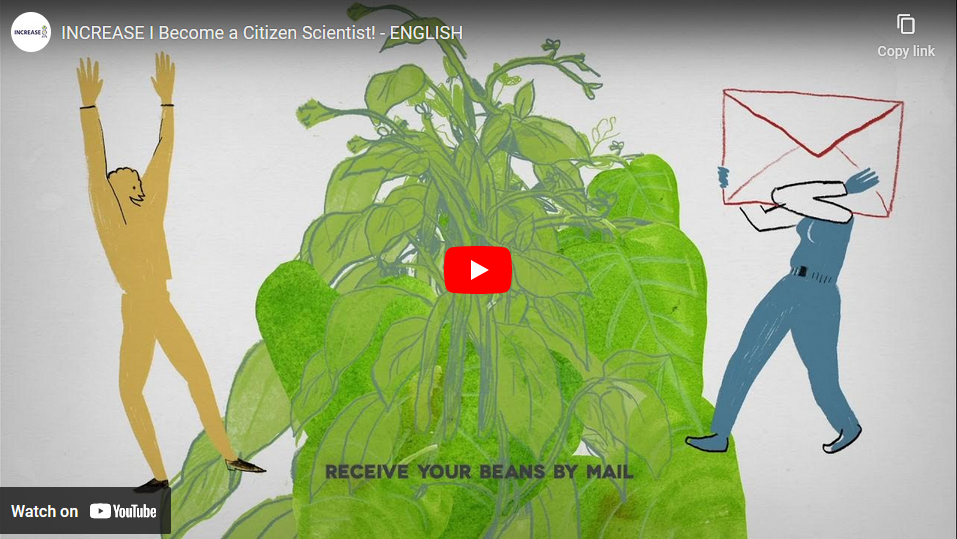
With the help of the common bean, you can get involved in:
- promoting genetic diversity of legumes in Europe
- disseminating scientific knowledge about genetic resources and food legumes
- developing a method and knowledge among citizens that could be applied to other crop genetic resources
- and establishing and testing a decentralised approach to genetic resources conservation, sharing and valorisation
What you will do as part of the experiment:
- receive a packet with a few different (ca. 5) bean varieties. They will be enough to fit in a mini plot in your garden, terrace or balcony.
- plant and grow bean seeds according to given instructions. The aim is to have at least one plant, as not all seeds may germinate…Your beans can be climbing or bushy types, you will get the information along with the seed package after we chose which varieties you will get (most likely you get both types, so be prepared to give them some a climbing help). Since beans do not tolerate frost, please sow your beans only when it is safely frost-free in your region.
- nurture your beans, collect and record information about them using the INCREASE CSA App that will constantly be updated with the necessary functions
- suggest tips and best practices, e.g. as text, images and videos, that could help other participants via the dedicated app
- Harvest the seeds and
- reproduce the seeds for the following years (we will distribute the seeds just once to each citizen but the citizen science initiative will run over four years). The seeds will then be multiplied by citizens that will keep the citizen science initiative running beyond the planned five years of INCREASE.
- offer the seeds for exchange to other citizens (using a protocol developed together with FAO)
- cook and taste them!
- send your assessment and recipes that will be included in “Thousands of traditional and innovative recipes to cook beans” published on the INCREASE website
Why would you take part?
- To contribute to the collection of information through
- assessing the potential and the diversity of more than 1000 common bean local varieties sampled originally from farmers’ fields
- measuring crop traits under local growing conditions showing the adaptation to different European environments and develop a photo gallery
- providing your preferences for bean colours, shapes and taste
- listing traditional and innovative cooking recipes and uses
- submitting narrative text describing local tradition, historical facts related to common bean but also original stories related to or involving the common bean
- using your own favourite common bean variety to be compared with those of the citizen science initiative and so contributing to the wider common bean databases
- To contribute to the use of information provided through
- exploring the huge resources developed with the help of all participants and compare different varieties including their DNA information that could help to reconstruct the history of dissemination of local varieties in Europe
- exchanging information and practices with other participants from the whole of Europe
- To contribute to exchanging seeds with other participants (following all the requirements of the international treaty on biodiversity and genetic resources promoting the benefit sharing)
- To contribute to developing new varieties by crossing and selecting specific variants
- To ultimately contribute to improve biodiversity in Europe, and improve nutrition through healthy diets that include legumes
If you have any questions about the Citizen Science Experiment, please reach out to Increase.CSE-team@ipk-gatersleben.de
Find out more on how to register for the Citizen Science Experiment via the INCREASE CSA app here.
- Go to your App store (Google Play or Apple App store) and search for INCREASE CSA.
- Download the INCREASE CSA App and install it on your smartphone.
- Register by entering a login email address and password.
- Proceed to the registration of the 2nd round of the Citizen Science Experiment by providing the required info for the shipping of your seeds.